Saturday, February 25, 2012

Overdue Blogpost


THERE ARE A LOT MORE PHOTOS AT THE END OF THIS POST

Hello dear family and friends, Yes, we should have written by now. Sorry. It's been quite an adventure over the last five weeks. Our days are full - we wake up at 6AM, leave the house at 7:15, walk 15 minutes to a bus, ride the bus about 20 minutes to the Peace Corp training center, and start class at 8AM. Riding the bus is like getting on a wooden roller coaster every morning to start the day - so bumpy and jerky. We have training until aprox. 5 PM, then walk 20 minutes to the bus, ride 20 minutes to town, walk 15 minutes home, and then hang with the family until about 8 or 8:30 PM eating dinner, talking, etc. Then most nights we have some homework, and hit the sack. It's a packed schedule, and most of it is in Spanish! So, it's been a lot to take in.

Whether we feel like it or not, I think we are slowly improving our Spanish. Also, we're learning a lot about the culture not only from class, but from our family. I've been writing down all of the meals our host mom makes, and watching her make certain things (or helping) so that I know what to buy, what stuff is at the market, and how to cook local foods when we are out on our own. We are learning to wash our clothes "on the rock" - yes, literally on a large rock slab out back in the yard, since this is likely what we will have to use once out at our sites. We've been given the opportunity to eat tripe (cow stomach), chicken foot, and worms. Guinea pig is also very popular here but we haven't been served it yet. Our host mom is starting to tease us now that she is going to sneak certain foods into our meals and not tell us what it is until a week later. Very funny! She is also making sure that we really learn how to wash our clothes on the rock. It is her responsibility to do so and she is taking it very seriously! My favorite thing so far was when our host mom was trying to tell us something the other day and when we couldn't understand her she walked into the other room, threw up her hands in the air, and said in Spanish "they don't understand anything I say". We did understand that and said, "we understood that"! It was quite funny and we all laughed. It was all in good humor.

A week ago they split up our team and sent us on "Technical Trips" to either the coast or the Amazon. Cherith went to the coast and Rich to the Amazon. These were not vacations by any means, as we were busy from morning to night working with and visiting existing development projects, some of which are successful and some that are not (so that we could learn from them). Some of the projects were tourism, chocolate farms, coffee farms, a native tea business, some activities in the schools, etc. We stayed in humble housing and were exposed to more of the poverty of the country than we have seen to date. I (Cherith) am definitely getting a better picture of life in lesser developed countries and the reality of it in everything from less variety in food (in the poorer communities), to unclean water, sanitary conditions, and differences in healthcare and access to it.

Now, on to some photos.

REMEMBER IF YOU CLICK ON THE PHOTOS YOU CAN SEE THEM BETTER.

 Our host parents during training.
 Making cheese empenadas that will be sprinkled with white sugar.
 Washing clothes out back on the "rock".
 Visiting a small mountain town that is in a "cloud forest". This town of 300 has a thriving community tourism business where visitors stay in the local's home, do hikes in nature, and the community sells cheese, jellies, handicrafts, and tree seedlings for re-forestation of Ecuadorian forests.
 A cool tree with moss in the cloud forest.
 Must have been a fun day. I think somebody needs a bath.
 On to the coast. Kids playing in the water at sunsest.
 Visiting one of several small coastal communities.
 Rice, coconut shrimp, and fried bananas.
 Some of the coast communities were very rural and no buses went there. So, we used these things, which go and return once a day. If you missed the return trip, you had to hitch a ride with someone. We paid a guy to drive us back in the back of his truck one day when we missed the return trip on this vehicle (I don't know it's name). I actually liked this thing. There was lots of fresh air and the view was great!
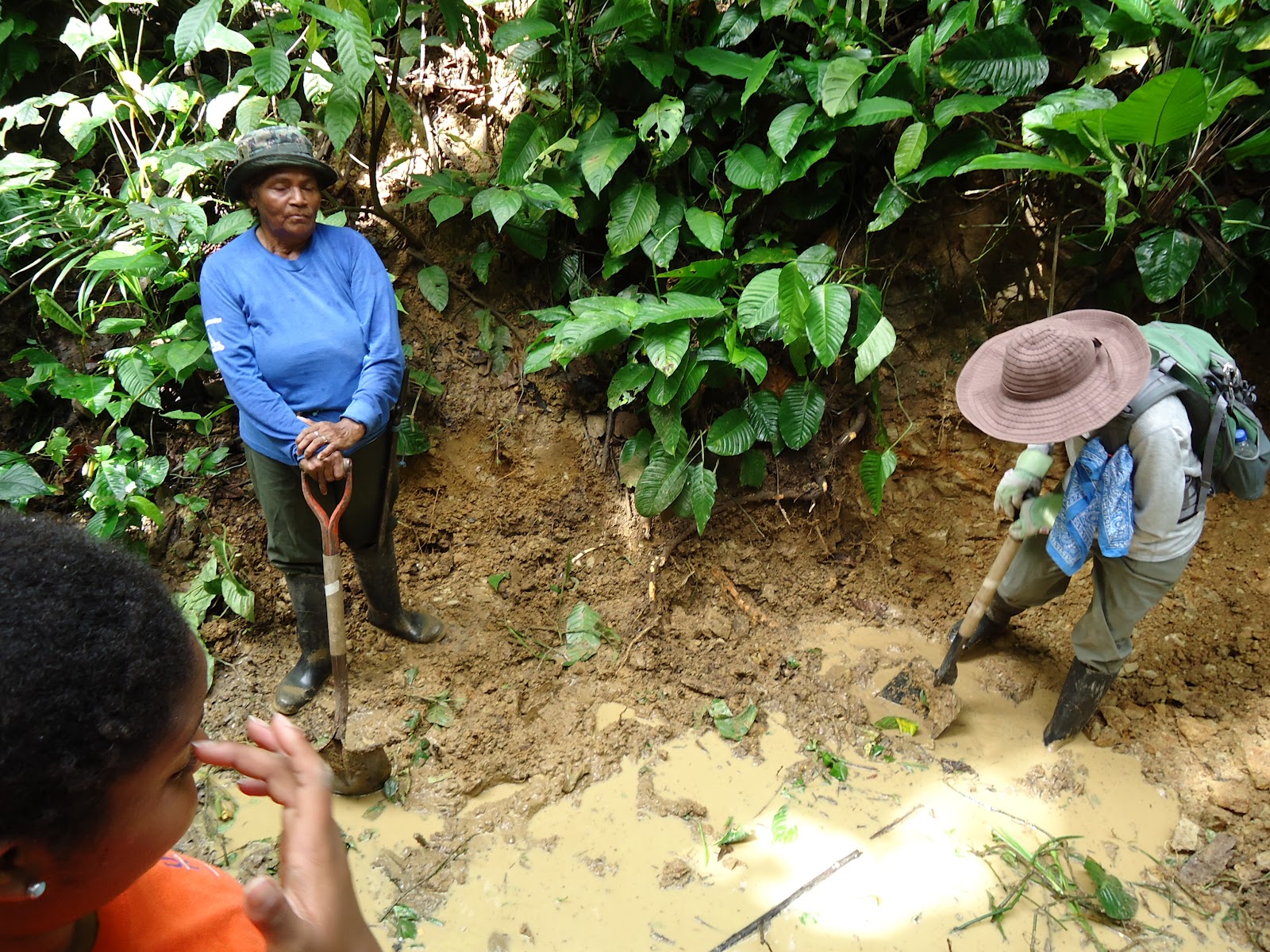
 We helped dig some terraces in a creek in the coastal jungle. This will help with water management. We also helped replant trees on the side of a hill this day (to help with reforestation and prevention of erosion). I saw about 5 real taranchulas here. I learned they don't hurt you. One even fell out of a tree onto my teacher.
 We played in this awesome waterfall on the beach. We also swam in the ocean. It was like bath water - awesome!
 Walking back to town.
 Another little community of a couple hundred where we did some activities in the local school.

Main street.


The beachfront of another little coastal pueblo where we visited a new marine reserve they are creating, second only to the Galapagos.

 This was the sign at a successful ecotourism project in the Amazon. And successful means that it was built by the locals, is run by the indigenous people and the money is shared in the community. The  Quechua are the indigenous people in this area.

They had lots of interesting animals and only the ocelots were in a cage. This was some kind of ant eater. He followed us around and you could pet him.
These were not for petting.
This guy's name was Lucas. He was quite entertaining.
They had a museum with models of the rafts and canoes, animal traps, blow guns, ritual items, etc.
And here's our group holding a Boa snake. I don't like holding snakes...
So I faced my fears and did this...for a short period of time.

And I made this little friend at a zoo in Tena (a town in the Amazon).


Saturday, January 28, 2012

Arrived Safely


CLICK ON PHOTOS TO SEE THEM BETTER/BIGGER
This is a view of the southern side of Quito, Ecuador, from a viewpoint on a high mountain above the city.
We have arrived in Ecuador safe and sound. We've been here for 9 days now - wow! Everything is going wonderfully. The Peace Corp is so organized and we are happy with all our trainers as well as the peers in our group (there are two other couples besides us).There are 37 people in our training group. After a couple nights in bunks at the Peace Corp training facility we were place with host families. Our family is wonderful! I was nervous about living with a family but I feel we have been blessed with a great family that fits us well. The mom is an excellent cook and we are enjoying all their fresh fruits and fruit juices straight off the trees in the yard, eggs from the chickens out back, etc. We've been tested on our Spanish and I am in a high beginner group and Rich is in a low intermediate group. We won't find out about our actual sites for work until the 6th week here so for now we are just learning a lot about the culture, language, safety and security, health, and they are learning about us. Here are some photos:

View from the patio on the top of the house we are living in.

It rains a lot (tropical) so the rain jacket my sister bought me is coming in very handy!


Tuesday, January 10, 2012

Home in Colorado

We've been home in the states since December 2, 2011. We leave for Ecuador with the US Peace Corps on January 18th, 2012. It's been wonderful to be here visiting family and friends and eating lots of yummy American food.


Wednesday, November 30, 2011

“Driving to the Bolivian border and back in a day" (Nov. 2011)


      After living in La Serena from July to November and experiencing way too many cool, cloudy days we decided to take a trip to a coastal town in northern Chile called Iquique in hopes of finding sun, warmth and warmer ocean temps. It's actually just a few hours from the Peruvian border. This town has very unique geography. It's about 200,000 people and sits on a plain next to the ocean. Behind the town about 2-3 kilometers are mountains essentially made of sand. Above Iquique is the Atacama desert...the driest desert on the planet. (This photo will give you some idea of the geography.)


       I also had great hopes for the skatepark that I'd read about and seen pictures of on the internet. Well the skatepark turned out to be terrible...badly designed, badly shaped and badly poured. Oh well...

     So after a few days of enjoying warm, sunny days by the beach we decided to rent a car and drive to a national park that we believed to be 2-3 hours northwest into the desert. We had already taken one trip by bus into the desert to a natural spring pool in a small oasis town called Pica. On this same trip we also visited a nitrite mining ghost town that was quite interesting. Using buses is much cheaper but takes much longer than renting a car. We ended up waiting at a bus stop on the highway by the ghost town for more than an hour before continuing on to Pica. And we barely made the last bus out of Pica to get back to Iquique.

     These photos of Humberstone don't even begin to show all that was there. This place had a town square, a theater, a swimming pool, housing for the miners and everything else a small town could need.

This was the swimming pool. (?)
Cherith looking beautiful while we wait for the next bus.
     Now back to our trip to Bolivia...  We were very excited to have a rental car. We made our plans with the maps we had. The car rental place didn't have maps of the region (?). So we headed into the desert in our rented Hyundai Elantra. The Elantra is a larger sedan by Chilean standards and we were excited to have it. And at this point I want to say that the hundreds and hundreds of kilometers of highways that we saw in our 9 months in Chile are comparable to those in the US. The difference being that most of them are two lane. Even the major north-south highway in Chile is primarily two lane.
     Our first stop was at the “Gigante de Atacama”. The “Giant” is the largest prehistoric anthropomorphic figure in the world with a height of 119 metres (390 ft.) and represents a deity for the local inhabitants from 1000 to 1400 CE. (See photo) And no, there wasn't a problem with crowds.
     As we continued to head up into the Andes mountains gradually gaining altitude I realized that words like stark and barren do not even begin to describe this geography. First, the Andes mountains have no trees. Yes, you read that correctly...no trees. At least from Santiago to the north the Andes have no trees. And in this part of the Atacama there really wasn't any form of vegetation at all. It actually reminded me of pictures of the surface of Mars. As we reached higher into the mountains we did start to see some plants and cactus. The higher altitudes do get some snow and rain. Eventually I passed a sign that said 4,350 meters. So I said to myself to just multiple by three and thought we were just over 12,000 ft. Well...no, we were over 14,000 ft. And we started at sea level.

     At our first site of Llamas we pulled over to see them closer and take pictures. It seems that water springs up in certain places in these mountains which allows grasses and plants to grow. The llamas feed off of this vegetation. And whether these were wild or somebody's livestock we weren't sure.

     After 3 hours and 45 minutes we reach Colchane at the Bolivian border which looked like a pretty big dot on the map we had. Well it wasn't. It was a village of about 150 people...I'm guessing. No place to buy gas which we needed in able to drive thru the national park and make it back to Iquique. Bummer. So we started by asking at the Municipal building. We get told that some people sell gas out of their houses or venders will sell it to you by the border. So we drive thru the mud brick houses looking for someone to ask and pretty much didn't see a soul. We drove up to the border check point, which was a bunch of official looking buildings to see if we could find someone to ask. At one point I'm convinced that I've drove across to the Bolivian side because when I tried to come back I was faced with a set of gates that wouldn't open and there was no one to talk to. In a state of panic, I walk into the office to ask what to do and a very helpful Bolivian border official tells me I had not actually crossed over and to just drive back out the way I came violating all of the traffic signs. Okay...I'm glad that's over.
This is to give you idea of what Colchane looked like. The national park we wanted to see is behind those colossal mountains.
     Safely back on the Chilean side of the border checkpoint I ask a man who is sweeping the curbs where I might find some gas. He says “I have gas, how much do you need?” Excellent. So I follow him back to the group of houses we had drove through earlier. He goes into his house, comes back out and says he only has diesel. Again...bummer.

     Next we proceed to the hotel/restaurant we had driven by earlier to see what there is to eat and deliberate on our options. It turns out to be a nicely decorated restaurant which caters to tour groups. We ask for a menu and basically get told the “menu del dia”. This means, here's what's for lunch today. The lunch was actually quite good...a traditional chicken soup and a pork chop sort of thing with some quinoa. After eating we talk to the manager about our prospects for still driving through the park and getting back to Iquique with the gas we have...using our two wheel drive Elantra. We end up deciding against it. The prospect of running out of gas late in the day in the middle of the Atacama desert did not sound fun.

     Outside the town we did stop at the big heard of Llamas we saw on the way in for some great pictures. And I actually ended up really enjoying the drive back. Just to be driving a nice car down from the Andes mountains on a good highway with almost no other traffic was fun. And we had our Ipod plugged into the stereo. We ended up making it back for dinner at the beach and great sunset.  The end.


Sunday, November 6, 2011

We were on the local news!


We were on the local news! The program that is funding our English teaching is government grant money. So the story was about our school getting the grant and our students qualifying for it. It was really strange having a camera man in my classroom. See if you can get the video in this link to work. 
Rich and Cherith on the news in La Serena, Chile 

Otherwise copy and paste this link into your browser.
http://www.24horas.cl/videosRegiones.aspx?id=50362&idRegion=4
Let us know if you can't get it to work.

Monday, October 17, 2011

Tickets Home!

Today we booked our flights to come home. We'll be back on December 2nd. Soooooooooooo excited!

This is mom getting off the plane in La Serena. Our airport is the smallest airport I've ever been to in my life. It's a one plane at a time kind of place.

Saturday, October 8, 2011

Mom is Visiting!

My mom has come to visit us in La Serena for two weeks! I am DELIGHTED! We have been having a lot of fun just hanging out, seeing the community and region, etc. It took her four flights, two short bus rides, and a 20 minute walk to get to our apartment. Wow. She is amazing. But, we're renting a car this weekend to make things a bit easier than walking and using buses all the time. She deserves it : )