Sunday, May 27, 2012

No water, too much water and our new apartment.

So we’ve been hearing a lot about the extremely dry spring that Colorado has been experiencing. And well, we don’t have that problem here in Bucay. We’ve been here for a month and half and it’s pretty much rained every night and sometimes in the day.  A week ago we moved into our new apartment just down the street from where we were living. We are very excited about our new apartment. It’s quite clean and nice. The little old lady who owns the building recently had it built. Basically all the houses or buildings here are set up with rebar and/or columns sticking out the roof so that when you want to add another floor you just add it on. So our apartment was built on half of the roof of our building so we are able to walk out onto a big terrace that’s bigger than our apartment. We share this space with the other apartments. People use it to dry their clothes. We’re on the fourth floor so we have nice views of the mountains when they’re not covered by clouds(which seems to be most of the time). And yes, we have to walk up three flights of stairs to get to our place.
                We found this place when we were here for our site visit back in early March. We were walking down the street and a little old lady asked us where we were living and if we needed a place to live. So we got to see it then and she basically held it for us while she continued to have work done on it. She had rented to a Peace Corps volunteer in the past so I think that helped us out.
                Now here’s where the fun begins… We’d visited the apartment several times before we moved in and we noticed that sometimes there was water and sometimes there wasn’t. We’d ask her about it and she’d say that she’d get it fixed or something like that. So we moved in a week ago knowing that there still was some problems with the water. For a few days we still showered back at our host families’ place.  We kept leaving our landlord notes asking her to do something about it. We’d fill buckets and tubs when we had water so we’d have it for washing dishes, bucket bathing and laundry.
                The first night we slept there it rained in the night (which is normal) but I also heard additional water hitting the roof. I get up to discover water in our main room which is leaking thru the ceiling just inside the door. We had been warned about water coming into the apartment but we thought it came from under the front door when it rained really hard. Well, come to find out it does that too. So I mopped up everything, put buckets down to catch the water and went back to sleep.  In the morning I began to investigate the problem. Right outside our door on the roof is a big blue cistern. We were told this would be our water or we shared this with another apartment. I conclude that this thing must be leaking which is causing our problem. I stack up two saw horses so I can climb up to check it out. I pull the lid off the tank and it’s empty.
To make a long story short, days go by of talking to neighbors, leaving notes with the landlord and trying to figure out the system. Then the neighbor below us tells us that there’s something very important regarding the functioning of the pump for our cistern in his apartment. We ask if we can see it. We go into his bedroom and coming in through his window is the electrical plug for the pump. (?) So he saysjust go buy some electrical cord so we can splice it in and run the cord up to our apartment. My response is, “Si, si, si!” So I buy the cord, he splices it in, I run it into our kitchen window, plug it in and just like that I’m filling the tank. I’m so pleased with myself that I send Cherith a text telling her that I think I solved our problem.  After it filled I was able to take a shower for the first time in our apartment! I send Cherith another text with the news of my shower.
Now if you’re paying attention this story started with water coming into the apartment (probably from the cistern).But I took great care to replace the hose clamp on the hose going into the cistern and I inspected the whole thing when it was full and it wasn’t leaking. So why then when Cherith returns several hours later was the tank empty? I was stumped.
The next day our host family sends over a guy who was doing work on one of their toiles to take a look at our problem…a plumber…of sorts. He looks things over and starts working on the water lines coming into the house down by the street. I was very skeptical of this approach but I didn’t interfere. He ended up installing  a one-way valve so that water won’t drain out of tank back into the water coming from the city. I’m very confused. It’s like we have water coming from the street and we have water from our cistern feeding into the same system.Whatever the situation,the water stops draining out of the tank.
That night we hear water hitting the roof again and it’s not raining. So we’re up in the middle of the night, standing  on a saw horse and shining a flashlight on the cistern. Water is overtopping the tank and running onto the roof (and the pump isn’t plugged in). In hopes of preventing the water from saturating the roof again and coming through the ceiling we turn on the kitchen sink and the shower. We’ve did that for like three nights. It’s such a waste. I conclude that at night, when no one is using water, the system is pressurized enough to fill our tank through the water outlet. So we get the plumber guy to come back and install another one-way valve on the water coming out of the tank so that water can’t back up into it.  And Viola! We now have the ability to fill our water tank, maintain the water in it and it doesn´t overflow at night. We are finally able to sleep through the night without have to deal with this issue in some way.
I´m sure we´ll find more problems with our apartment but for now we´re happy.

These pics are just to give you an idea of what our place looks like.
Obviously this is before we moved in...
 

Wednesday, April 25, 2012

Living in Bucay

One of the many amazing waterfalls in our county.
(MORE PHOTOS AT END OF TEXT)
We have been living in Bucay, Ecuador, the place we were stationed by the Peace Corp, for almost three weeks now. We graduated from our three month training program right before moving here. Previous blog posts have updates on the graduation and a map of where Bucay is located in Ecuador. 

Our assignment in Bucay is to be Small Business Advisors for the development of tourism and small businesses associated with tourism in this county. The people we are assigned to work most closely with we call “counterparts”. We seem to have some excellent counterparts and we are so happy about this. We are working with the government of the county of Bucay, a local foundation called Fundacion NOBIS, and the state Government. Bucay is located at the base of the Andes Mountains, right where they hit the plains that stretch out flat all the way to the ocean. There is a plethora of potential outdoor activities for tourists here, such as hiking in rain forests, rafting, kayaking, tubing, visiting amazing waterfalls, horseback riding, swimming in rivers, repelling down waterfalls, and visiting a local indigenous community. Bamboo grows all around and is used to create beautiful structures. Also, there is an old train station that is being renovated (this is being paid for by the government of Ecuador) as a tourist train that will bring a lot more tourists.

Right now Bucay has some tourists, and some of the potential tourist sites are useable, but many need more development in order to be used. Ninety percent or more of the tourists are Ecuadorian. They say the other 10% are international. We haven’t seen anybody yet. Although, we definitely think it is a place foreigners would like once developed a little more. We are definitely the only foreigners here and we stand out – a lot. Our first two weeks here we spent in a truck bouncing around the back roads visiting a plethora of potential tourist sites, hikes, hostels, restaurants, etc. At each site we were to experience the attraction and complete paperwork regarding its potential for tourism, if tourists would be interested or not, what would need to be done to make it ready for tourists, etc. This was very interesting, but also long days and lots of work. Several families killed chickens and made lunch for us as we were the guests in the area. We met so many wonderful tour guides, community members and families who are hopeful that they may be able to increase their standard of living if they can get some help with developing the resources that they have. We hope we can find a good place to fit and offer our knowledge and skills. We definitely can offer the prospective of a foreign tourist, which will help them a lot I think, in the long run. But, we also plan to help with marketing, research, feasibility studies for small businesses, business planning, managing money (basic accounting), computer issues, relationship building between players, and more….we’ll see.

Right now our first three month’s job is to meet as many people as we can, see as much as we can, become accepted in our community (as we said we really stand out), hang out with our family and friends, and most important of all – LEARN SPANISH. We have a teacher we meet with twice a week, and we study on our own…we think we are learning. It is painfully slow!

We miss all of you, our family and friends, a lot. Life here is night and day from what we are used to. We are doing a lot of adjusting. Currently we live with a host family. We have 30 roosters that live outside our bedroom window and wake up at 2AM every morning and crow all night (we bought a fan to drown out the noise so we can sleep, and we have earplugs). We can walk everywhere in town. We buy fish from a guy walking down the street selling them (which our family is going to teach us how to clean), meat from a butcher shop (if you want hamburger meat you pick a piece of meat and they grind it up for you), and chicken from a little store where they hang from a bar out front (raw, unrefrigerated). It is quite an adventure!
We are two hours from Guayaquil, which is the largest city in Ecuador. Guayaquil and Quito are the only two international airports. 

I guess this is the basics. If you want more details, feel free to send me a message here and I can share more. There is so much more….We know people like pictures, so hopefully you’ll enjoy those we put in this blog post.

 A hike in the surrounding mountains.
A view while hiking.

 Bucay is the little city of 10,000 below - that is where we live. We work there and out here in the surrounding mountains and plains.

 More waterfalls. There are seven in just one area, and more elsewhere.
Us with our work partners, getting very wet.

A alley in town.
 One of the charming little catholic churches.
 Tin roof of the vegetable market.
 Vegetable market.
 Meat market.
 Fruits sold along the side of the main road that goes through town.

 One of the main streets in town.
 The old train station....they are going to be remodeling it and using the train as a tourist train. The train is in Spain right now being fixed. It is suppsed to be up and running early next year....
 They love to play volleyball here. And, they bet on most of the games. The average winnings is $30 or so per game per person. This goes on every night.
 Another main street.
The main river through town.
The backs of the homes and buildings along the river.
Some yummy local lunch.
Along the river is a "malecon". This is a nice park area they fixed up as a pleasant place for the locals to hang out and enjoy. This boat is a building and we are going to be using the inside of it as our office. We have it cleaned up (from dirt and spider webs) and the next step is to paint it. Pretty cool. Also, we hope to get internet there. Right now we go to internet cafes and pay for it every day, which adds up.
 These next few photos are on the "malecon" that is along the river.

 Cherith on the malecon.


Wednesday, April 11, 2012

Graduation!!!

Until you complete the 11 weeks of Peace Corps training you not officially a ¨Volunteer¨. We survived the training and had our graduation on April 4th. It was quite a nice, formal event with the Country Director and the Consular General from the Guayquil consulate leading the ceremony. (Cherith was starting to walk off before I could get here pic like this. Sorry Cherith.)

Here is the oath we had to take. It´s essentially the same oath that indivuals take when they´re swearing into the military. The big differences being that we won´t get any weapons training and we can say we want to go home at any time.


And here we are next to JFK, the president that started it all. The Peace Corps is 51 years and they´ve been in Ecuador for 50 years.


  Here´s the stage without any people. It was a nice event. Now, on to Bucay for the next chapter of our experience...more to follow.

Friday, March 2, 2012

Site Assignment - Where We Will Live For The Next Two Years

The way things work in the Peace Corp is that your first three months are training. Around week 4 they take you on a week trip to some part of the country (a "tech trip") to learn more about the country and the type of work you may be doing. The photos from our tech trips are in the blog post just before this one. Then, in week 6 they announce to you where you will be stationed for the next two years. You have NO choice whatsoever in the decision, so as you can imagine there is a lot of anticipation wrapped up in hearing what your "site" will be. Yesterday we found out our site is called "Bucay". It is the large red dot surrounded by a star in the photo map below:
To give you some reference:
*This is a map of Ecuador, outlined in red.
*The large red dot surrounded by a star is where we will be living!!
*The two large red dots together are Quito, the capital of Ecuaodor, and the town next door is where we are currently training.
*The X on the right side of the map is where Rich went for his "tech trip" in the Amazon - you can see photos in the blog before this one.
*The X towards the top left of the country, on the coast, is where Cherith went for her "tech trip". You can see photos in the blog before this one.
*There are two international airports into Ecuador. One is in Quito (where the two red dots are), and one is in Guayaquil, which is the large red dot to the left of the dot with the star (in case any of you ever want to fly in and visit - ha, ha!).

Our town is about 10,000 people but it sounds like there is another town right next door with another 10,000 or so. So, we are in one of the more populated areas compared to some of our other volunteers. It is a 3 - 4 hour bus ride from the coast. It is in a "transitional" zone which means its in the middle between the mountains, the ocean, and the amazon. The temperature is 64 - 82 degrees year round and humid. We will be living with a family for the first 6 months. Three local organizations - a foundation, a tourism board, and the state government have requested help with development of tourism in the area and some possible environmental education and/or assistance. The area seems to have four or five rivers that run into it, as well as numerous waterfalls. It is a very bio-diverse area with a lot of potential for tourism as income for the local population. We have learned all this from Peace Corp staff. We will actually be going to visit next week, for a week. After our week there, we have four more weeks of training here at the training center, and then we move there officially for the next two years.

Saturday, February 25, 2012

Overdue Blogpost


THERE ARE A LOT MORE PHOTOS AT THE END OF THIS POST

Hello dear family and friends, Yes, we should have written by now. Sorry. It's been quite an adventure over the last five weeks. Our days are full - we wake up at 6AM, leave the house at 7:15, walk 15 minutes to a bus, ride the bus about 20 minutes to the Peace Corp training center, and start class at 8AM. Riding the bus is like getting on a wooden roller coaster every morning to start the day - so bumpy and jerky. We have training until aprox. 5 PM, then walk 20 minutes to the bus, ride 20 minutes to town, walk 15 minutes home, and then hang with the family until about 8 or 8:30 PM eating dinner, talking, etc. Then most nights we have some homework, and hit the sack. It's a packed schedule, and most of it is in Spanish! So, it's been a lot to take in.

Whether we feel like it or not, I think we are slowly improving our Spanish. Also, we're learning a lot about the culture not only from class, but from our family. I've been writing down all of the meals our host mom makes, and watching her make certain things (or helping) so that I know what to buy, what stuff is at the market, and how to cook local foods when we are out on our own. We are learning to wash our clothes "on the rock" - yes, literally on a large rock slab out back in the yard, since this is likely what we will have to use once out at our sites. We've been given the opportunity to eat tripe (cow stomach), chicken foot, and worms. Guinea pig is also very popular here but we haven't been served it yet. Our host mom is starting to tease us now that she is going to sneak certain foods into our meals and not tell us what it is until a week later. Very funny! She is also making sure that we really learn how to wash our clothes on the rock. It is her responsibility to do so and she is taking it very seriously! My favorite thing so far was when our host mom was trying to tell us something the other day and when we couldn't understand her she walked into the other room, threw up her hands in the air, and said in Spanish "they don't understand anything I say". We did understand that and said, "we understood that"! It was quite funny and we all laughed. It was all in good humor.

A week ago they split up our team and sent us on "Technical Trips" to either the coast or the Amazon. Cherith went to the coast and Rich to the Amazon. These were not vacations by any means, as we were busy from morning to night working with and visiting existing development projects, some of which are successful and some that are not (so that we could learn from them). Some of the projects were tourism, chocolate farms, coffee farms, a native tea business, some activities in the schools, etc. We stayed in humble housing and were exposed to more of the poverty of the country than we have seen to date. I (Cherith) am definitely getting a better picture of life in lesser developed countries and the reality of it in everything from less variety in food (in the poorer communities), to unclean water, sanitary conditions, and differences in healthcare and access to it.

Now, on to some photos.

REMEMBER IF YOU CLICK ON THE PHOTOS YOU CAN SEE THEM BETTER.

 Our host parents during training.
 Making cheese empenadas that will be sprinkled with white sugar.
 Washing clothes out back on the "rock".
 Visiting a small mountain town that is in a "cloud forest". This town of 300 has a thriving community tourism business where visitors stay in the local's home, do hikes in nature, and the community sells cheese, jellies, handicrafts, and tree seedlings for re-forestation of Ecuadorian forests.
 A cool tree with moss in the cloud forest.
 Must have been a fun day. I think somebody needs a bath.
 On to the coast. Kids playing in the water at sunsest.
 Visiting one of several small coastal communities.
 Rice, coconut shrimp, and fried bananas.
 Some of the coast communities were very rural and no buses went there. So, we used these things, which go and return once a day. If you missed the return trip, you had to hitch a ride with someone. We paid a guy to drive us back in the back of his truck one day when we missed the return trip on this vehicle (I don't know it's name). I actually liked this thing. There was lots of fresh air and the view was great!
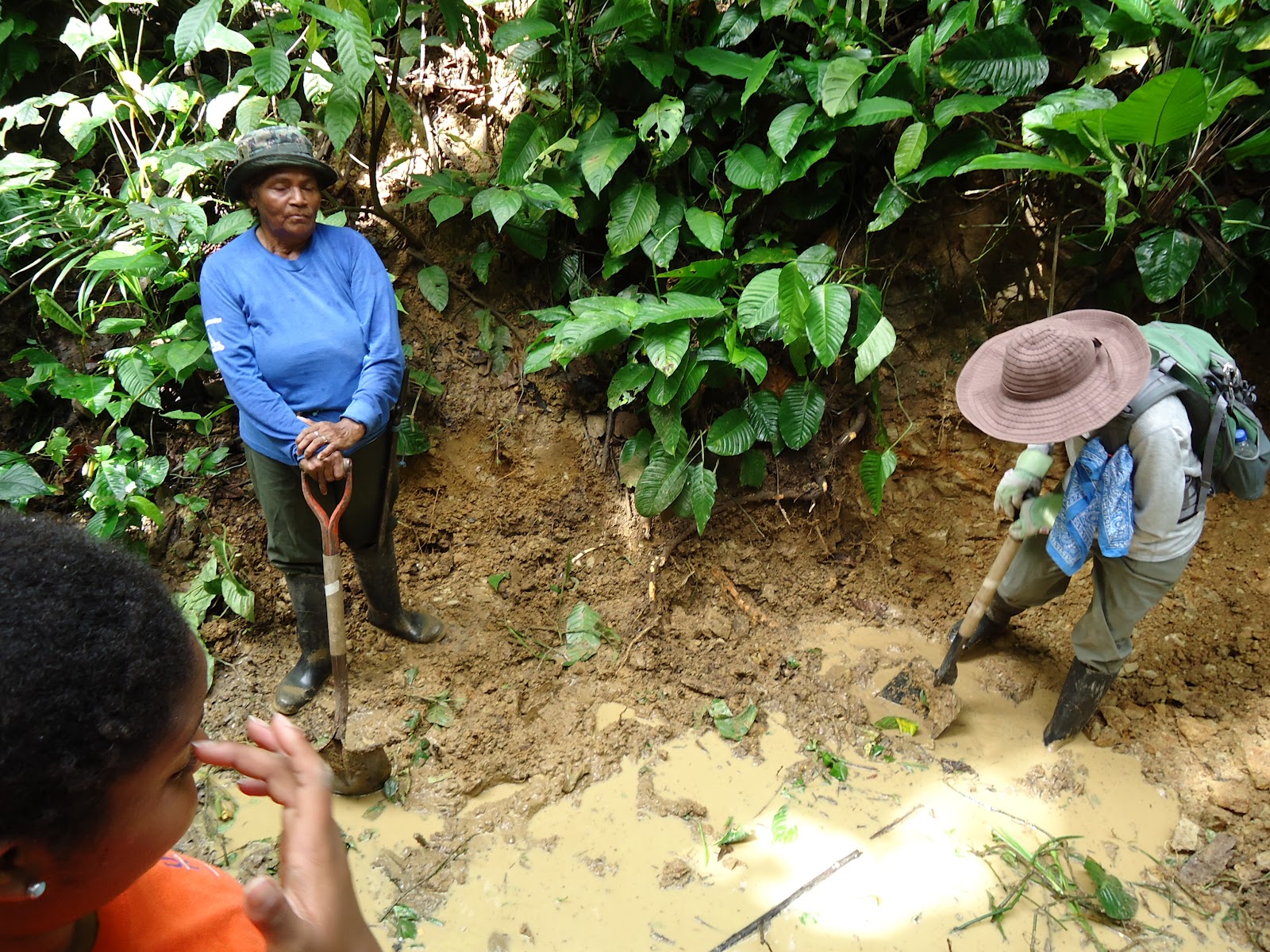
 We helped dig some terraces in a creek in the coastal jungle. This will help with water management. We also helped replant trees on the side of a hill this day (to help with reforestation and prevention of erosion). I saw about 5 real taranchulas here. I learned they don't hurt you. One even fell out of a tree onto my teacher.
 We played in this awesome waterfall on the beach. We also swam in the ocean. It was like bath water - awesome!
 Walking back to town.
 Another little community of a couple hundred where we did some activities in the local school.

Main street.


The beachfront of another little coastal pueblo where we visited a new marine reserve they are creating, second only to the Galapagos.

 This was the sign at a successful ecotourism project in the Amazon. And successful means that it was built by the locals, is run by the indigenous people and the money is shared in the community. The  Quechua are the indigenous people in this area.

They had lots of interesting animals and only the ocelots were in a cage. This was some kind of ant eater. He followed us around and you could pet him.
These were not for petting.
This guy's name was Lucas. He was quite entertaining.
They had a museum with models of the rafts and canoes, animal traps, blow guns, ritual items, etc.
And here's our group holding a Boa snake. I don't like holding snakes...
So I faced my fears and did this...for a short period of time.

And I made this little friend at a zoo in Tena (a town in the Amazon).